Ezra – “Coming Out Of Babylon”

Click here to view or download Ezra Bible study

The book of Ezra tells the story of the Jewish return from captivity.  Babylon had become Persia – and the new King of Persia issued a decree saying the Jews could go back home, after 70 years in a foreign land.

What should have been a mass exodus of Jews from Babylon turned out to be only a trickle of people returning home.  They had gotten pretty comfortable in that far-away place, and, well, not very many really cared that much about making the long, dangerous trip home.  For most of the Jews living in Babylon/Persia, the home of their enemies had become their home, and they stayed.

But for some the permission to return home to the land of Israel was the best news they had ever heard, and the news they had been expecting  for 70 years.  Some of them had been born in Babylon, the children of the original captives.  Some of them were the grandchildren and great-grandchildren of the original captives.  They got their few belongings together, sold everything else, and walked home.  It was hard, it was hot, it was exhausting, and once they got there they had lots of hard, hot and exhausting work to do in order to have a place to live again.

But the draw to home was overwhelming.  They had to go to the land God had given them so long ago.  They wanted to once again fulfill their mission – tell the world about the One, True God.

We’ll see some painfully clear parallels to our own lives in this part of Jewish history.  We’ll see ourselves loving our lives and comfortable in our own “Babylon”.  We’ll wonder what it actually means for us to “leave Babylon”.  We’ll wonder if the sacrifices of leaving Babylon are worth it.

But I think we’ll also see that the message from the Lord is clear:

 “Come out of her, my people, lest you share in her sins, and lest you receive of her plagues”  – Revelation 18:4

Click here to view or download individual chapters of this Ezra Bible Study.

Matthew 28:16-20 “And Then They Went”

Click here to view or download Matthew 28:16-20
Click here to view the entire Matthew Bible Study
Click here or on the image to the left to view or download this Matthew 28:16-20  Bible study.
After Jesus leaves the grave He tells His disciples: “I can do anything I want right now.  I could destroy all enemies right now.  Instead, I choose to send you forth to tell My story.  You will make disciples, baptize them, and teach them My words.  I will be with you as you go…until the time finally comes when the Father says to me: “Go back, Son!”.  

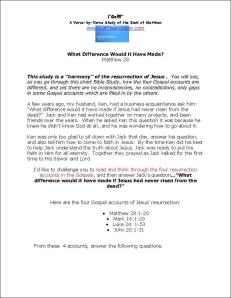
Matthew 28 “What Difference Would it have Made?”

Click here to view or download Matthew 28

Click here to view the entire Matthew Bible Study

Click here or on the image to the left to view or download this Matthew 28  Bible study.

A few years ago, Ken had a business acquaintance ask him:  “What difference would it have made if Jesus had never risen from the dead?”  Jack and Ken had worked together on many projects, and been friends over the years.  When Jack asked Ken this question it was because he knew he didn’t know God at all…and he was wondering how to go about it.

Ken was only too glad to sit down with Jack that day, answer his question, and also tell him what it meant to put his faith in Jesus.  By the time Ken did his best to help Jack understand the truth about Jesus, Jack was ready to believe in Jesus.  Together they prayed as Jack talked for the first time to His Savior and Lord.

Matthew 26:30-75 “The Worst Day of My Life”

Click her to view or download Matthew 26:30-75

Click here to view the entire Matthew Bible Study.

Click here or on the image to the left to view or download this Matthew 26:30-75 Bible study.

Two men were about to have the worst day of their life.

Peter:  Peter did not believe he was capable of denying Jesus.  He was going to learn, however, that his own personal power – his own sense of commitment – his own physical strength  – his own emotional stability – his own mental capacities…. none of those things were going to be worth anything at all from here on out.

Judas:  Judas was loved by Jesus.  He created him, and He was about to die for him.  He had just spent the last 3 years living with him, laughing with him, teaching him, and giving him every opportunity on earth to believe that He was, indeed, God Himself. But Judas did not want to live by faith.  He wanted to live the way he always had.

Matthew 26:17 – 29 “Jesus’ Last Week – Thursday – The Passover Dinner”

Click here to view or download Matthew 26:17-29

Click here to view the entire Matthew Bible Study.

Click here or on the image to the left to view or download this Matthew 26:17-29 Bible study.

So….was Jesus crucified on Thursday…or Friday?  And was the Passover Dinner on Thursday…or Wednesday?  My answer?  Not sure.  But the question comes up, then – Is it wrong to have questions about the Bible?

So here’s the way to approach a question about a puzzling scripture passage:  Don’t say, “Hmmm…have I found something which proves the Bible is false in some places?”.

Instead, say, “I know the scripture is true…that’s a given… so what else am I not understanding? or What other verses will help me sort this out?  or Maybe I have to let this one cook for awhile and I’ll understand it later.”

It’s perfectly OK to think and question.  But don’t question God’s character, or the truth of the Bible.  Questioning God or the truth of the Bible gets you exactly nowhere.

Matthew 26:1-16 “Tuesday (or Wednesday)” of the Last Week

Click here to view or download Matthew 26:1-16

Click here to view the entire Matthew Bible Study.

Click on the image to the left to view or download this Matthew 26:1-16 Bible study.

The Jewish leaders chose to kill Jesus because leaving Him alive might mean their “kingdom” would slip away from them.

Judas chose to betray Jesus because he might be able to gain the fame and wealth he so craved.

Sin…Aren’t There Some Sins not as Bad as Others?

Click here to view or download Bible study on Sin

Click on the image to the left to view or download this Bible study on “Sin…Aren’t There Some Sins not as Bad as Others?”

We all know murder and cruelty are big sins – bad sins, in fact.  But, seriously, is telling a small lie really such a big deal?

Our Church in Greenwood Celebrates its First Anniversary

Village Bible Church one-year anniversaryMy husband, Ken, and I were part of a new church plant in our area last year – Village Bible Church met for it’s first worship service in Greenwood, Indiana, about a year ago, July 15th 2012.

We are so thankful to be a part of this small group of loving people who just want to spread the story of Jesus as far and wide as we can before the Lord returns.

On July 14th we will be celebrating our One-Year Anniversary – if you are in the area you are especially invited to come celebrate with us.

Click here to get more info:  http://villagebiblechurch.net/2013/06/20/village-bible-church-one-year-anniversary-july-14th/

Question: “Why did Jesus turn the Water into Wine…Didn’t People Get Drunk?”

John Chapter 2 – Jesus is at a wedding and turns water into wine.   Isn’t it wrong for people to get drunk?  Why did He do this?

This is a very good question, and many people ask it.  Here’s my understanding of the whole alcohol/drinking/drunkenness problem:

  1. Acutally, The Bible does not say it is wrong to drink alcohol.
  2. There are many well-meaning people who think when Jesus made water into wine it wasn’t actually alcoholic in content, but I think that’s too big a stretch.   Most people in Jesus’ day (and before) drank wine with their meals, because the water of the day was not clean, and would easily make people sick.  The wine (because of the alcohol content)  was not so full of germs as the water.
  3. The Bible does say drunkenness is wrong.  To drink wine to excess is what is wrong.   Drunkenness would be defined as drinking so much alcohol a person is not making coherent decisions, or is feeling free to act in sinful ways.
  4. So, in answer to your question, Jesus turned water into wine because they needed it for the wedding – but it was each person’s responsibility to monitor their own drinking limits.

Does that help?  It might not answer every possible angle of your question, but maybe it gives you a good starting point to continue to think it through.